Announcing DevToolkit v1.0 — 21 Developer Tools, Completely Offline
We built a free, open-source desktop app with 21 developer utilities that runs entirely offline. No accounts. No data leaving your machine. Download it today.
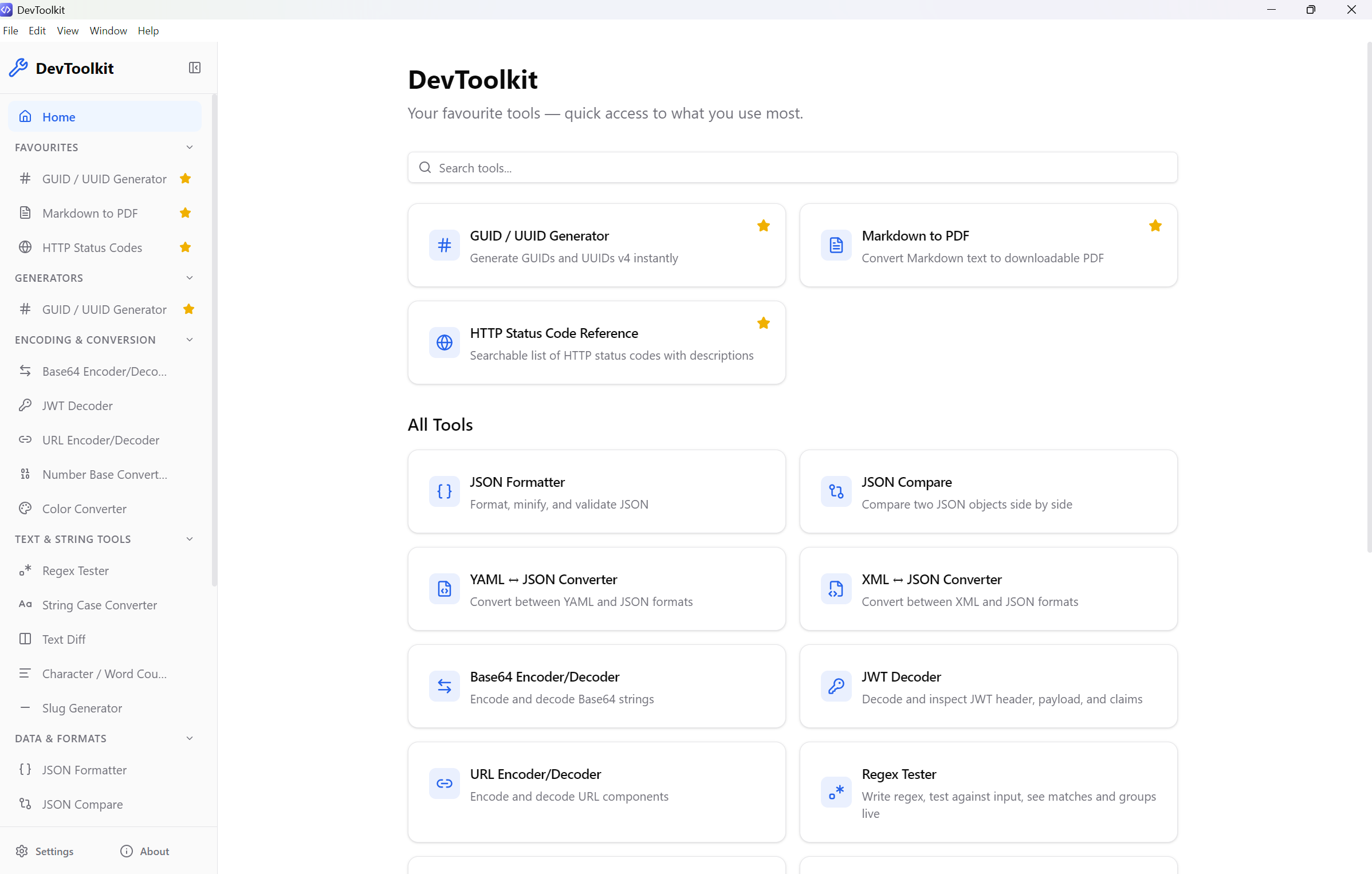
Every developer has a collection of browser bookmarks for small utility tasks — a JSON formatter here, a Base64 decoder there, a JWT inspector on yet another tab. These tools are scattered across dozens of websites, each with their own quirks: some inject ads, some require sign-ups, and almost all of them process your data on a remote server.
We asked a simple question: What if all of these tools lived in one app on your desktop, and none of your data ever left your machine?
That question became DevToolkit.
What Is DevToolkit?
DevToolkit is a desktop application for Windows, macOS, and Linux that bundles 21 essential developer utilities into a single, beautiful interface. It’s built with Electron, React, TypeScript, and Tailwind CSS — and it works completely offline.
No internet connection is needed. No accounts. Every byte of data you paste into DevToolkit stays on your local filesystem.
The Tools
We focused on the tools developers actually reach for every day:
Data wrangling — Format JSON, compare JSON objects, convert between YAML/XML/JSON, parse cron expressions, and export Markdown to PDF. These cover the daily back-and-forth of working with APIs, configs, and documentation.
Encoding and decoding — Base64, URL encoding, JWT inspection, number base conversion (hex, octal, binary), and color format conversion (HEX, RGB, HSL). The bread and butter of debugging and data inspection.
Text manipulation — Regex testing with live match highlighting, case conversion across 7 formats, side-by-side text diff, character/word counting, and slug generation. Small tasks that add up to hours of saved time.
Security-conscious hashing — Generate MD5, SHA-1, SHA-256, and SHA-512 hashes from any text input. All computed locally using the Web Crypto API, so your input never touches a network.
Reference tools — A searchable HTTP status code reference with 38 status codes grouped by category, and a CIDR/subnet calculator for quick network math.
Time conversion — A Unix timestamp converter with a live clock, bidirectional epoch-to-date conversion, and timezone awareness.
Every tool launches with sample data pre-loaded so you can see exactly how it works before pasting in your own input. And every tool output has a copy button for instant clipboard access.
Privacy as a Feature, Not a Marketing Line
This isn’t a tool that “respects your privacy” while silently phoning home. DevToolkit makes zero network requests. The Electron app loads from local files. There is no update check, no crash reporter, no analytics SDK. Audit the source code yourself — it’s all open.
This makes DevToolkit ideal for working with production data, air-gapped environments, security-conscious teams, and regulated industries where sensitive data processing must stay strictly local.
Dark-First, Developer-First Design
Dark mode is the default. The interface uses semantic design tokens for a consistent, polished experience across all 21 tools. Pin your favourites to the sidebar, search tools in real time, and enjoy consistent UX patterns across every tool — input on the left, output on the right, with clear and copy buttons in the same spots.
Open Source, MIT Licensed
DevToolkit is released under the MIT license. Use it, fork it, extend it, contribute to it.
Get Started
git clone https://github.com/AseemGaurav/DevToolkit.git
cd DevToolkit
yarn install
yarn dev
Or download the latest release for your platform.
What’s Coming Next
We’re already planning more tools: Lorem Ipsum Generator, QR Code Generator, JSON Schema Validator, SQL Formatter, and CSV ↔ JSON Converter. We’re also exploring plugin architecture for community-contributed tools.
Have an idea? Open an issue on GitHub — we genuinely want to hear what tools you wish existed.
DevToolkit is free, offline, and open source. Download it, pin it to your taskbar, and stop pasting sensitive data into random websites.